Before it comes down on its own
Dead & Hazardous Tree Removal in Jersey City, NJ
Dead and decayed trees taken down carefully, since they cannot be climbed or felled like healthy ones.
- Free on-site estimates
- Written quote before work starts
- Cleanup and haul-away included
Why Dead Trees Need a Different Approach
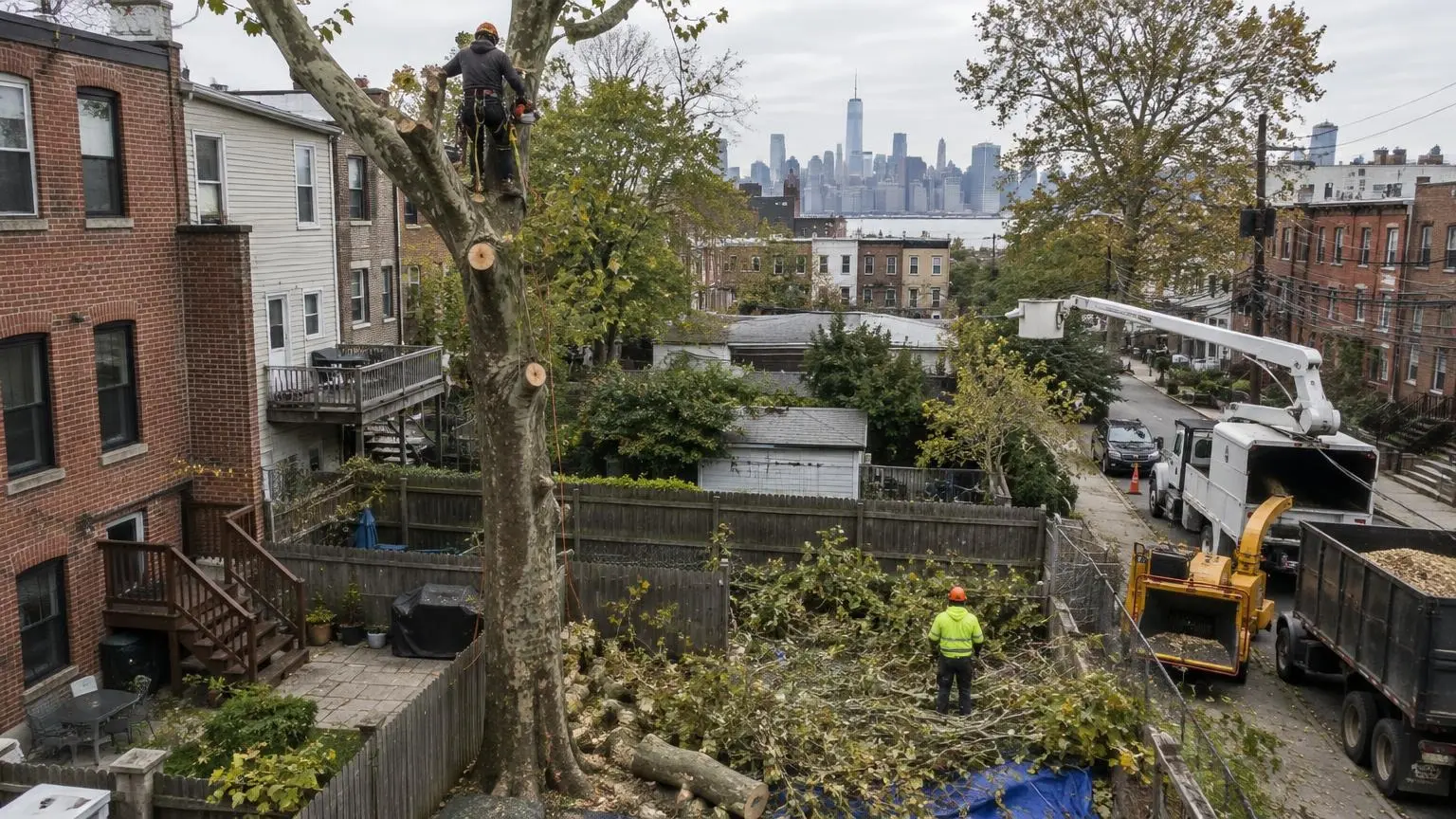
Dead and hazardous tree removal takes more planning than removing a healthy tree. Dead wood dries out and turns brittle, so limbs can snap under a climber's weight or break unpredictably when cut. Decay inside a trunk may not show from outside. In a dense city, where a dead tree often stands over a house, a parked car or a sidewalk, the safest removal is a planned one.
Emerald ash borer
The emerald ash borer was first confirmed in New Jersey in Bridgewater in 2014, and the state Department of Agriculture advises treating every ash tree in New Jersey as high risk. The state Department of Agriculture estimates New Jersey has about 24.7 million ash trees and warns that once infested, nearly all of them die, often within a few years. Dead ash is especially brittle. If an ash tree has a thinning crown, bark splits or woodpecker damage, removal may be the practical choice; whether it can be treated is a question for a New Jersey Licensed Tree Expert.
Signs a tree may be dead or failing
- No leaves in season, or leaves only on part of the crown
- Bark falling away, cracks or cavities in the trunk
- Mushrooms or fungal growth at the base or on the trunk
- A new lean, or soil heaving on one side of the base
- Large dead limbs hanging over the house, sidewalk or street
How we remove dead trees safely
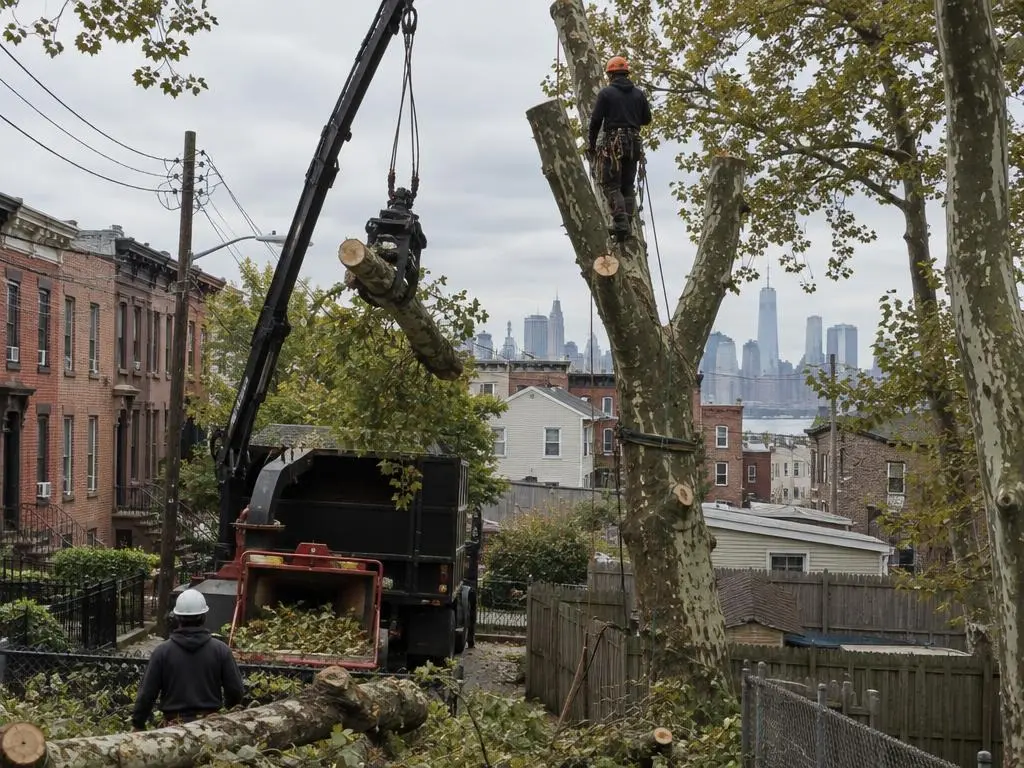
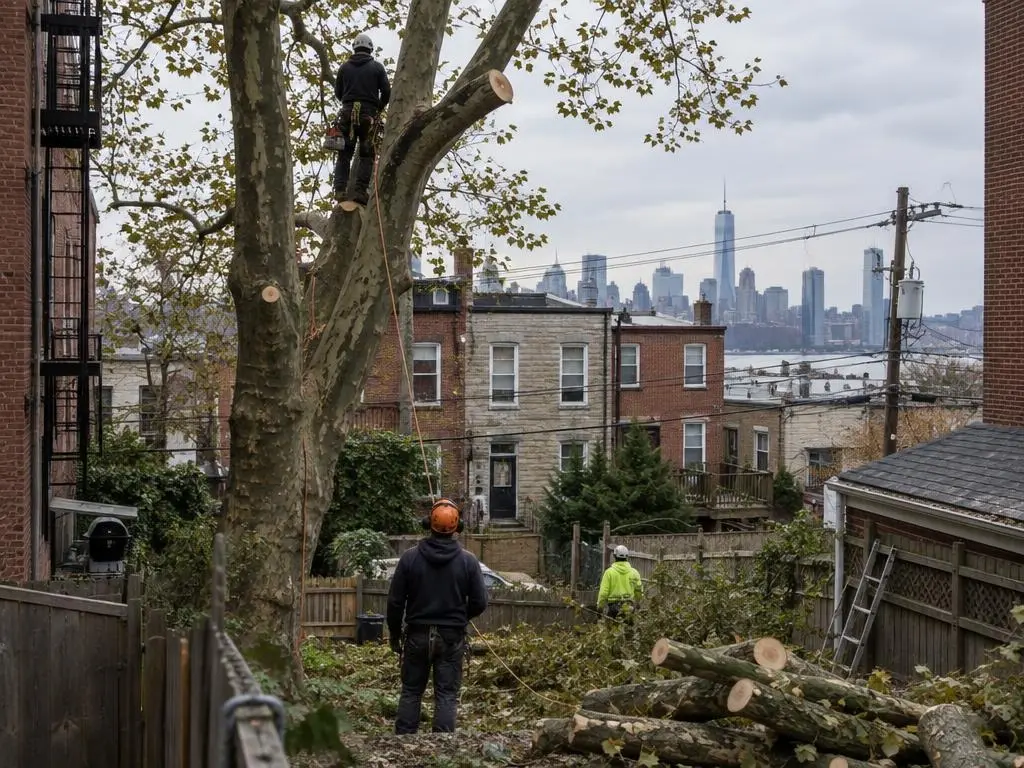
Where a climber cannot safely work in a dead canopy, we use a lift or a crane so the crew is not relying on brittle wood. Sections are kept small and controlled, and the drop zone is cleared and protected.
Dead trees and town rules
Several towns in the area require notice or a permit even to remove a dead tree, and some waive fees for dead or dangerous trees when documented. If the tree is a street tree, the town is usually responsible for it. We tell you what applies before scheduling.
Lanternflies and other pests
The spotted lanternfly quarantine covers every New Jersey county, including Hudson. Lanternflies favor the invasive tree-of-heaven, a fast-growing weed tree that often springs up along fences and in neglected corners of yards, and owners who want it gone can have it cut down along with other work, though it tends to resprout from its roots. Jersey City also has history with invasive pests: the Asian longhorned beetle was found here in 2002, and the state was declared free of it in 2013 after a long eradication effort.
What This Covers
Removal planned around brittle wood and hidden decay.
Dead ash removal
Removing ash trees killed or declining from emerald ash borer.
Decayed and hollow trees
Trees with trunk cavities, fungus or root decay taken down in controlled sections.
Leaning trees
Trees with a new lean or lifting roots taken down in controlled sections.
Dead limb removal
Large dead limbs over roofs, sidewalks and parking removed from otherwise healthy trees.
Typical Tree Removal Costs by Height
| Tree height | Published national range |
|---|---|
| Up to 30 ft | $150 to $500 |
| 30 to 60 ft | $450 to $1,200 |
| 60 to 80 ft | $800 to $1,500 |
| Over 80 ft | $1,000 to $2,000 |
Published national ranges from Angi (2026), Forbes Home (2024 to 2025) and Fixr (2025). Prices in the New York metro area can differ from national averages, and access, height, wires and haul-away change the total. Your written estimate sets the price.
How It Works
1. Plan the removal
We look at what the tree could hit and how it can be taken apart safely.
2. Choose the method
Climbing, lift or crane, depending on how sound the wood is.
3. Remove in sections
Small controlled pieces, lowered or lifted out.
4. Clean up
Wood is chipped and hauled away; stump grinding is optional.
Dead & Hazardous Tree Removal Questions
Is a dead tree more expensive to remove?
Sometimes. Brittle wood can rule out climbing and call for a lift or crane, which adds cost. A dead tree also gets harder and riskier to remove the longer it stands.
Should I treat my ash tree or remove it?
The New Jersey Department of Agriculture advises homeowners to treat all ash as at risk and to decide between treatment and removal with a licensed tree expert. If you decide on removal, we can quote it.
Who is responsible for a dead tree on my neighbor's property?
Generally the property owner. In Jersey City, residents can report a hazardous tree on a neighbor's property to Housing Code Enforcement at (201) 547-3824.
Do I need a permit to remove a dead tree?
It depends on the town and whether it is a street tree. Some towns waive fees for dead trees but still want notice. We check before scheduling.
Dead & Hazardous Tree Removal Service Areas
- Tree Removal in Jersey City, NJ
- Tree Removal in Hoboken, NJ
- Tree Removal in Weehawken, NJ
- Tree Removal in Union City, NJ
- Tree Removal in West New York, NJ
- Tree Removal in Guttenberg, NJ
- Tree Removal in Bayonne, NJ
- Tree Removal in North Bergen, NJ
- Tree Removal in Secaucus, NJ
- Tree Removal in Kearny, NJ
- Tree Removal in Harrison, NJ
- Tree Removal in East Newark, NJ
- Tree Removal in Newark, NJ
- Tree Removal in Belleville, NJ
- Tree Removal in Nutley, NJ
- Tree Removal in Elizabeth, NJ
- Tree Removal in Fort Lee, NJ
- Tree Removal in Cliffside Park, NJ
- Tree Removal in Edgewater, NJ
- Tree Removal in Fairview, NJ
- Tree Removal in Ridgefield, NJ
- Tree Removal in Ridgefield Park, NJ
- Tree Removal in Hackensack, NJ
- Tree Removal in Leonia, NJ
- Tree Removal in Lyndhurst, NJ
- Tree Removal in North Arlington, NJ
- Tree Removal in Rutherford, NJ
- Tree Removal in East Rutherford, NJ
- Tree Removal in Bloomfield, NJ
- Tree Removal in Montclair, NJ
Get a Dead & Hazardous Tree Removal Estimate
Free estimates for dead and hazardous trees.