
On top of the Palisades, beside the George Washington Bridge
Tree Removal in Fort Lee, NJ
Cliff-top yards, wind off the Hudson and a borough tree code worth reading before the first cut.
- Free on-site estimates
- Written quote before work starts
- Cleanup and haul-away included
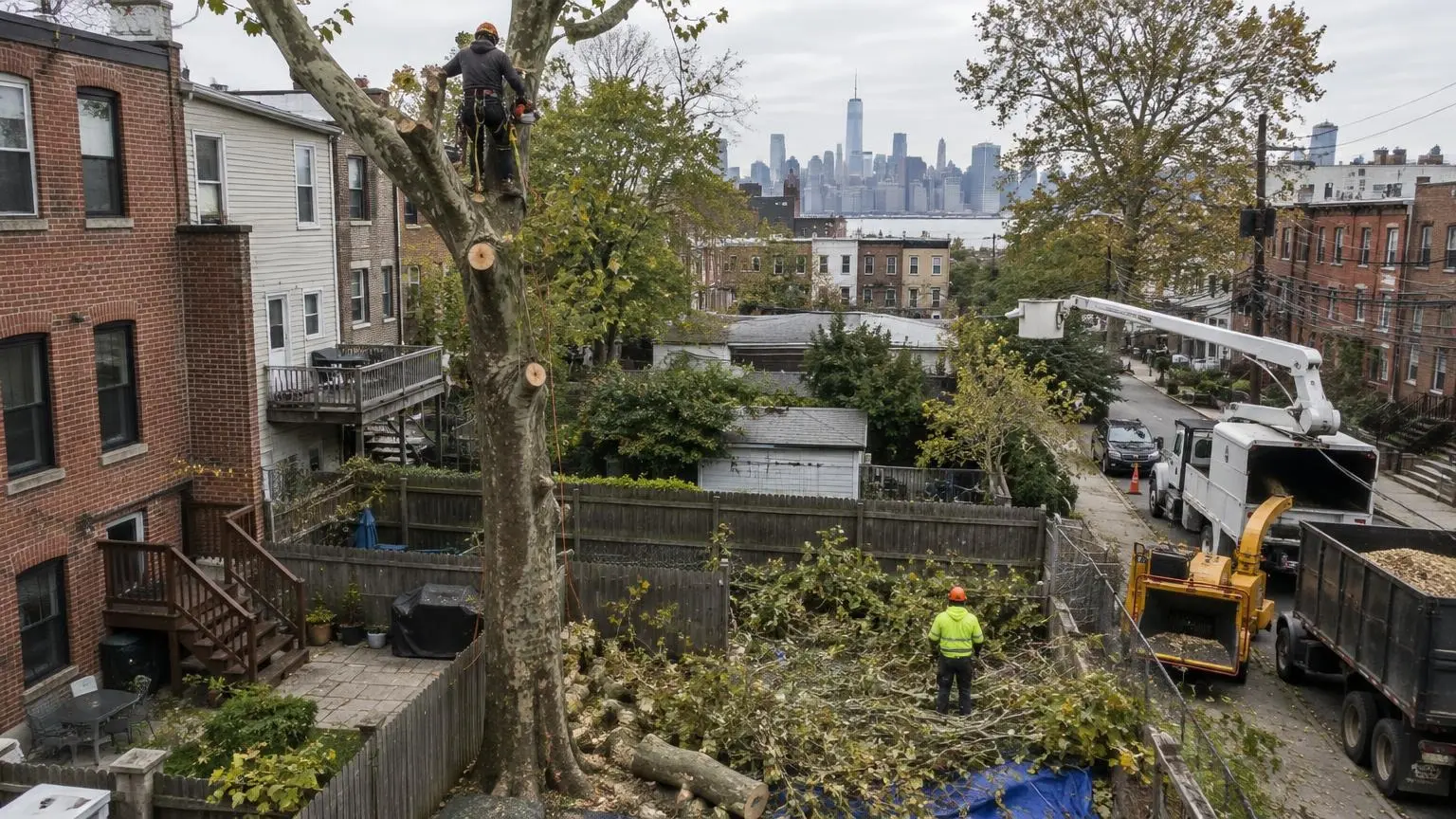
Removing Trees on the Fort Lee Palisades
Tree removal in Fort Lee often starts with paperwork. The borough sits on the Hudson Palisades, with cliffs rising to roughly 260 feet, and it has its own tree law: Chapter 156, Tree Removal and Replacement, adopted in 2002. That chapter makes it unlawful to take down, destroy or badly damage a tree wider than six inches (measured four and a half feet above grade) unless a tree removal permit has been issued. We plan every Fort Lee job around that rule from the first visit.
Our part is the work itself: a free on-site estimate, a written quote that lists exactly which trees come down and how, and full cleanup with all the logs, brush and wood chips taken off the property. If the tree needs a permit, we walk you through what we see on the property so you can bring clear details to the borough, which makes the permit decision.
What Chapter 156 says, in plain terms
- The Construction Official receives and indexes applications (§ 156-5).
- The filing fee is listed at $75 per tree, waived when an owner-occupied one- or two-family home is removing a single tree.
- The Construction Official inspects and can approve removal when, among other reasons, a tree is dead, diseased or in danger of falling, or creates an unsafe condition (§ 156-6A).
- Owners of one- and two-family homes may remove one tree every three years without meeting those criteria (§ 156-6B).
- Pruning that does not harm the tree's health is allowed (§ 156-4).
Rules change, so confirm the current requirements with the Fort Lee Construction Official before any removal. We describe the code here; we do not give legal advice.
Replacement rules when construction is involved
For removals tied to a site plan, subdivision or building-permit application (§§ 156-7 and 156-8), § 156-9 requires one replacement tree on site for every 12 inches of trunk diameter removed, using nursery stock of at least 3½-inch caliper. Where planting on the lot is not practical, it calls for a payment into the municipal tree replacement fund of $500 for a tree 6 to 24 inches across, or $1,000 for anything larger. If a tree is coming out to make room for an addition, a garage or other permitted work, ask the borough early whether these provisions reach your project, since they can change its budget.
Cliff-edge yards and Hudson wind
Homes near Hudson Terrace and the eastern edge of town face open air over the river. Trees growing on thin soil above rock, with nothing between them and the water, carry more wind load than the same species in a sheltered backyard. On these lots our work plan maps where each limb and section of trunk can be set down, away from the house, the slope and the neighbor's driveway. Sectional removal, with cut wood roped down rather than dropped, is the usual approach where the landing zone is small or sloped.
Between the towers and the two-family streets
Since the 1960s, high-rise apartment buildings have lined the Palisade Avenue and Boulevard East corridor, and the George Washington Bridge itself stands 604 feet tall. Away from that corridor, side streets with detached and two-family houses and yard trees come with parked cars, overhead lines and narrow driveways. We plan truck placement, cones and a clear drop area before the first cut, and we keep the sidewalk passable while we work.
When a removal cannot wait
A split trunk after a storm, or a large limb resting on a roof or a wire, is an emergency call. If lines are involved, call PSE&G first and keep everyone clear. For trees resting on a house, call us at (201) 957-7596 and we will tell you what we can do and when.
Fort Lee Facts That Affect Tree Work
- A six-inch threshold. Chapter 156 covers any tree more than six inches in diameter measured 4 feet 6 inches above grade, and each tree removed without a permit counts as a separate violation (§ 156-10), with fines up to $2,000.
- One tree every three years. Under § 156-6B, owners of single- and two-family homes may remove one tree every three years without meeting the dead, diseased or unsafe criteria in § 156-6A. Ask the borough before you count on it.
- Dense, and split between owners and renters. Fort Lee packs about 15,962 people into each square mile of its 2.52 square miles of land (2020 Census). Owners occupy 55.4% of housing units, and the typical owner-occupied home is valued at $448,000 (American Community Survey, 2020-2024).
- Cliffs and a 33-acre historic park. Fort Lee Historic Park is a 33-acre cliff-top park on the Palisades just south of the George Washington Bridge, where Americans began fortifying the site in July 1776 before retreating from it on November 20, 1776.
Fort Lee Questions
I own a two-family house in Fort Lee. Do I need a permit to take down one healthy tree?
Chapter 156 still requires a permit application, but § 156-6B lets owners of one- and two-family homes remove one tree every three years without proving it is dead, diseased or unsafe, and the $75 fee is listed as waived for an owner-occupied home removing a single tree. Get the borough's confirmation of those details first.
Does trimming count as removal under the borough code?
Section 156-4 allows cutting, pruning or trimming that does not harm the tree's health or vitality. Heavy cutting that endangers the tree is treated differently, so if you want a lot of crown taken off, ask the borough first and we will write the quote as a pruning plan you can show them.
If I can't fit a replacement tree on my lot, what then?
Section 156-9 applies to removals tied to development or building-permit applications. In those cases, if on-site replacement is not feasible, it calls for $500 per tree 6 to 24 inches across and $1,000 for larger trees. Ask the borough whether it applies to your removal.
My tree sits near the edge of a steep slope. How do you take it down?
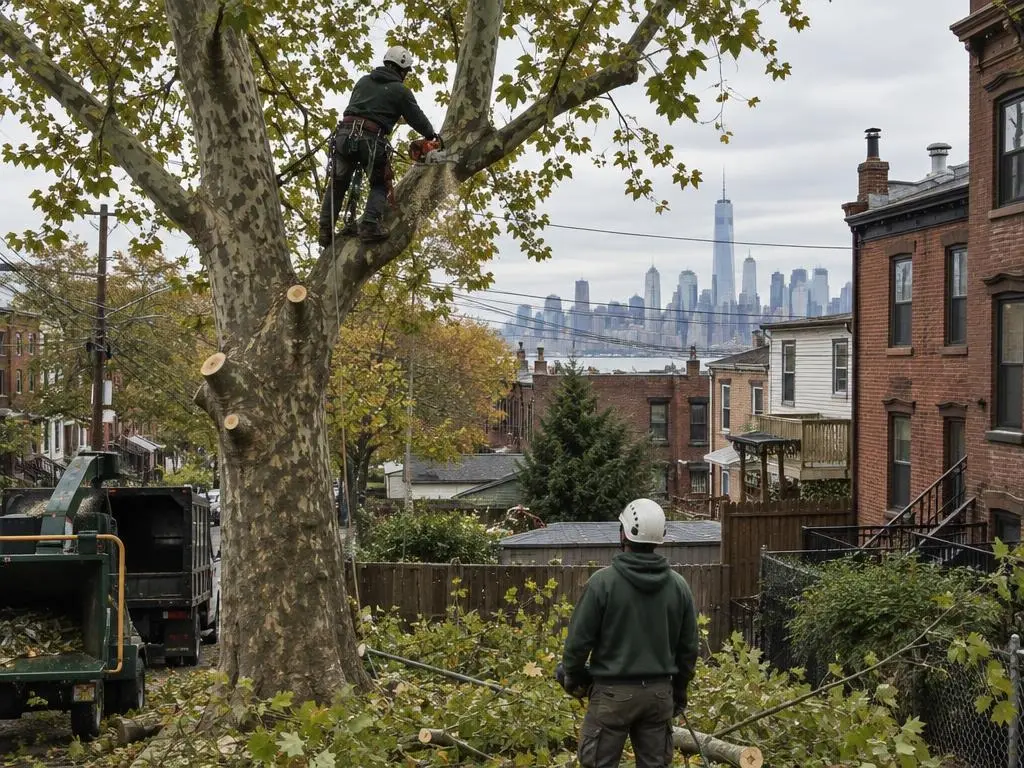
We dismantle it from the top down, roping each cut to keep pieces from tumbling down the slope or toward the house. On the estimate visit we check the footing for the crew and where every piece can land safely.
Tree Removal Near Fort Lee
- Tree Removal in Jersey City, NJ
- Tree Removal in Hoboken, NJ
- Tree Removal in Weehawken, NJ
- Tree Removal in Union City, NJ
- Tree Removal in West New York, NJ
- Tree Removal in Guttenberg, NJ
- Tree Removal in Bayonne, NJ
- Tree Removal in North Bergen, NJ
- Tree Removal in Secaucus, NJ
- Tree Removal in Kearny, NJ
- Tree Removal in Harrison, NJ
- Tree Removal in East Newark, NJ
- Tree Removal in Newark, NJ
- Tree Removal in Belleville, NJ
- Tree Removal in Nutley, NJ
- Tree Removal in Elizabeth, NJ
- Tree Removal in Cliffside Park, NJ
- Tree Removal in Edgewater, NJ
- Tree Removal in Fairview, NJ
- Tree Removal in Ridgefield, NJ
- Tree Removal in Ridgefield Park, NJ
- Tree Removal in Hackensack, NJ
- Tree Removal in Leonia, NJ
- Tree Removal in Lyndhurst, NJ
- Tree Removal in North Arlington, NJ
- Tree Removal in Rutherford, NJ
- Tree Removal in East Rutherford, NJ
- Tree Removal in Bloomfield, NJ
- Tree Removal in Montclair, NJ