
1.25 square miles of brownstones and tree pits
Tree Removal in Hoboken, NJ
Taking down and pruning trees behind attached rowhouses and along Hoboken's gridded blocks, with the city paperwork sorted out first.
- Free on-site estimates
- Written quote before work starts
- Cleanup and haul-away included
Tree Work on Hoboken's Tight Grid
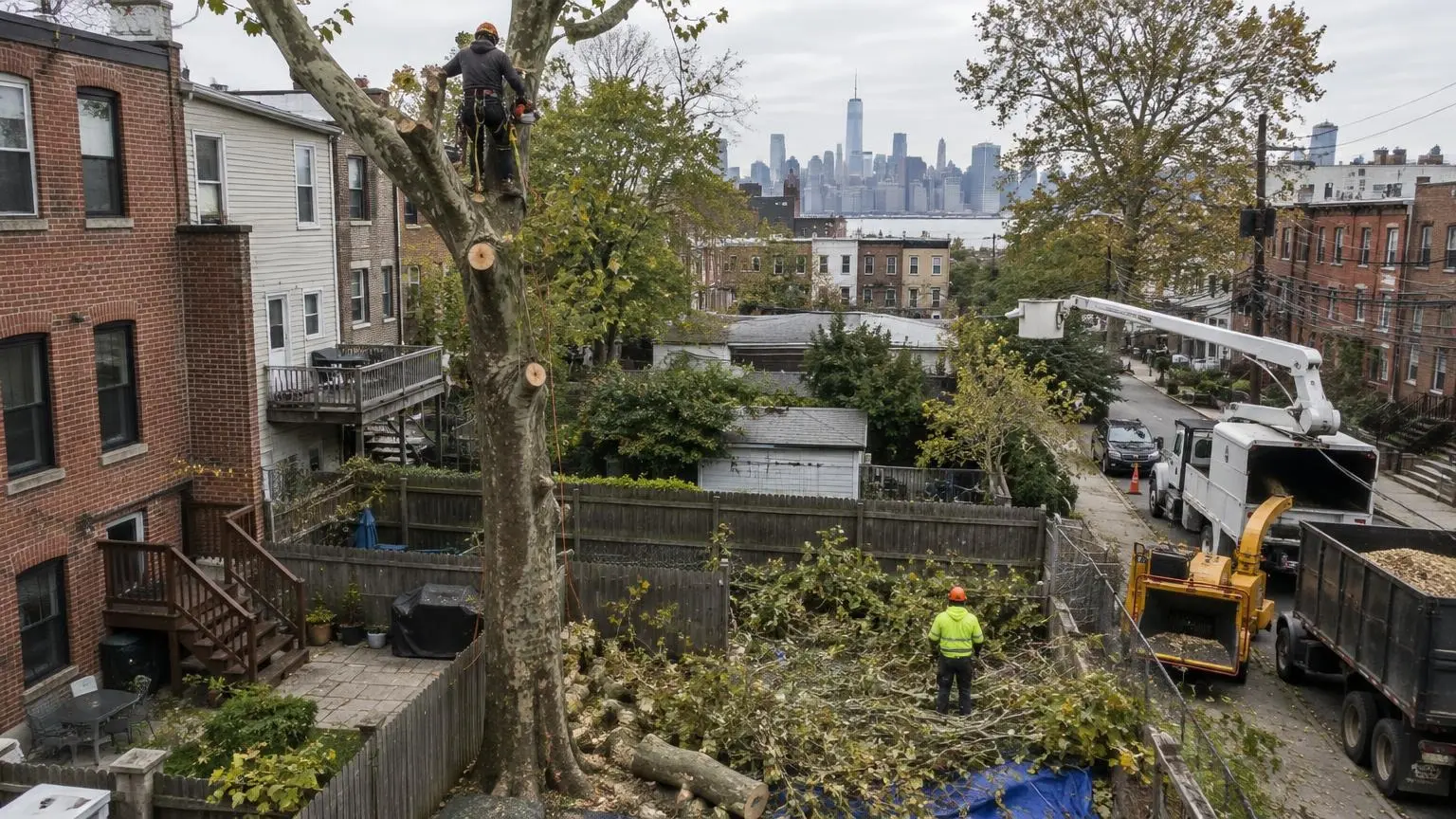
Tree removal in Hoboken often starts as a logistics problem, not a cutting problem. The city fits about 60,000 people onto 1.25 square miles of land, and much of it is built as attached masonry rowhouses, three to five stories tall, set on the street grid that Colonel John Stevens's land company laid out in the 1800s. A backyard tree behind one of those buildings may have no side yard, no alley and no driveway leading to it.
Getting a tree out from behind a rowhouse
When there is no outside path to the yard, the job gets planned around the building itself. The usual options are:
- Dismantling the tree in small, hand-sized sections and carrying them out through the hallway, with floors and door frames covered to protect them
- Lowering pieces on ropes to keep them from swinging into windows, fire escapes or the neighbor's fence
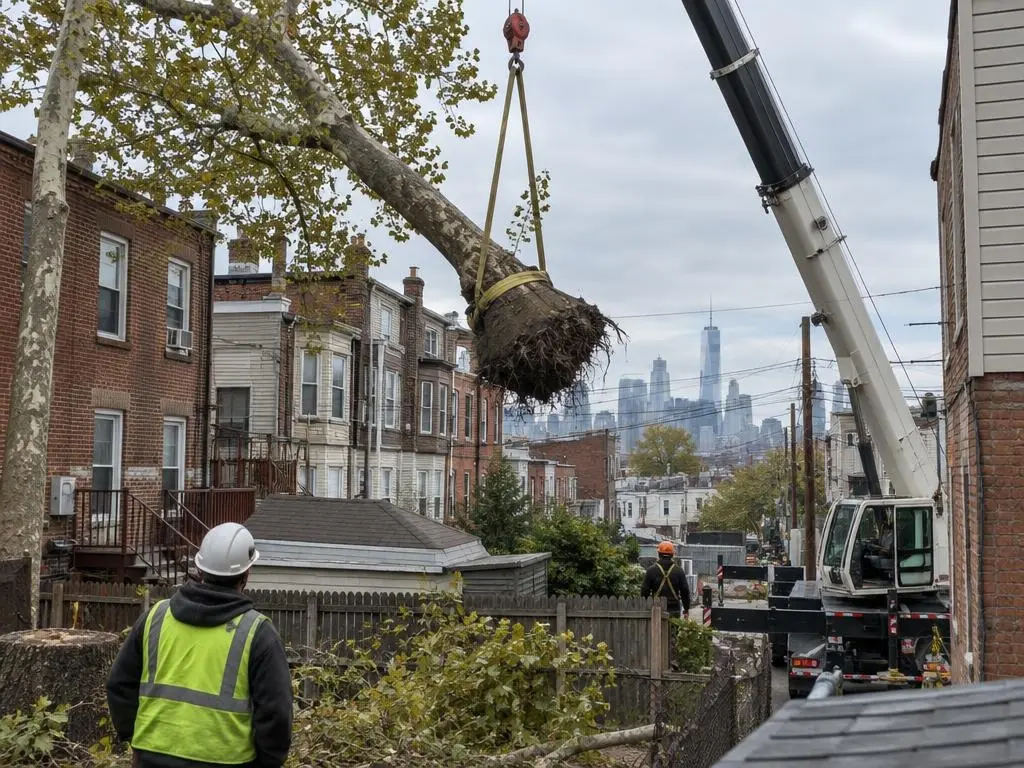
- Lifting sections over the roofline with a crane parked on the street, which takes curb space and usually city sign-off
- Grinding the stump with a narrow machine that fits through a standard doorway, or cutting it flush if no grinder can reach it
We study the route before quoting, because access shapes the time and the price more than the height of the tree does.
Street trees fall under Chapter 169
Hoboken rewrote its tree rules in July 2024. Chapter 169 of the city code requires a permit before anyone cuts or removes a tree on a street or in a public place, and the city's own FAQ says that even pruning the street tree in front of your building calls for a tree permit through the Shade Tree Commission and the Department of Climate Action & Innovation. Replacement scales with trunk size: a removed tree between 2.5 inches (street) or 6 inches (non-street) and 12.99 inches DBH calls for one new tree, while a trunk of 33 inches or more calls for four, each at least 3 inches in caliper. Section 169-6 generally exempts trees that are dead, severely diseased or severely damaged, and trees whose angle of growth makes them a hazard to structures or people, from replacement. Rules get revised, so confirm with the Shade Tree Commission before any removal.
Water, salt and soft soil
Hurricane Sandy pushed seawater over roughly half of Hoboken in October 2012, and the city has spent the years since building resiliency parks and underground stormwater storage. Saturated soil gives roots less grip. If a tree starts to lean after a soaking, consider removal, or have it evaluated by a licensed tree expert before deciding. On soft ground, we set up so heavy equipment stays on pavement wherever possible.
Higher ground near Castle Point
Not every part of Hoboken sits at flood level. Castle Point, where Stevens Institute of Technology stands on a serpentine rock outcrop, is the highest ground in the city. Trees on that rise and along the riverfront walkway can take more open wind off the Hudson than trees tucked between buildings on interior blocks, and that affects how much weight we take out of a canopy during trimming.
What every Hoboken job includes
Each estimate is free and done in person, and you get the quote in writing. Cleanup and haul-away of the wood, brush and chips are part of the job, which matters in a city with nowhere to stack logs at the curb. Call (201) 957-7596 to set up a visit.
Hoboken Details That Affect Tree Work
- Dense, high-value, mostly rented. Hoboken counted 60,419 residents in 2020 on 1.25 square miles of land (48,335 per square mile). Owners live in just 33.8% of units, and the median value for owner-occupied units is $895,100 (Census QuickFacts, 2020-2024). With roughly two-thirds of units renter-occupied, the building owner may need to approve tree work.
- Chapter 169 fees and penalties. Section 169-14 lists a $100 fee for a tree permit on projects that do not go before a land use board, and Section 169-15 sets penalties of $250 to $2,500 for each tree cut, damaged or destroyed in violation of the chapter.
- Sandy and the resiliency parks. Sandy flooded about 1,700 Hoboken homes in 2012 and caused roughly $100 million in damage. The 5.4-acre Northwest Resiliency Park, opened in June 2023, can store up to 2 million gallons of stormwater.
- Rules for new street tree pits. Section 169-12 calls for street tree pits at least 3 feet wide and 5 feet long (15 square feet), a recommended spacing of 25 to 35 feet on center (15 feet minimum), and no new tree grates in the right-of-way.
Hoboken Questions
My brownstone has no side yard. Can the backyard tree still come out?
In most cases, yes. The tree can be taken down in small sections and carried through the building with floors protected, or lifted over the roof by a crane set up on the street. We look at the route on the free estimate visit and explain which method fits your building.
Do I need city approval to prune the street tree in front of my building?
According to the city's FAQ, pruning a street tree in front of your property requires a tree permit through the Shade Tree Commission and the Department of Climate Action & Innovation. Check with the city before any work on a street tree, since the tree sits in the public right-of-way.
If a street tree is removed, does a new one have to be planted?
Chapter 169 ties replacement to trunk size, from one new tree for smaller trunks up to four for trunks of 33 inches or more, and generally exempts dead, severely diseased or severely damaged trees, plus trees whose angle of growth makes them a hazard to structures or people. The code also allows a payment of $2,000 per tree into the Shade Tree Trust Fund for trees that cannot be planted. The Shade Tree Commission makes those calls, so confirm with them first.
A tree on my block sat in floodwater. Should it come down?
Not automatically. Flooding and saturated soil can loosen a tree's hold on the ground. If it shows a new lean, soil heaving at the base or large dead sections in the crown, consider removal, or have it evaluated by a licensed tree expert first. We can quote removal, or pruning out dead wood, in writing.
Tree Removal Near Hoboken
- Tree Removal in Jersey City, NJ
- Tree Removal in Weehawken, NJ
- Tree Removal in Union City, NJ
- Tree Removal in West New York, NJ
- Tree Removal in Guttenberg, NJ
- Tree Removal in Bayonne, NJ
- Tree Removal in North Bergen, NJ
- Tree Removal in Secaucus, NJ
- Tree Removal in Kearny, NJ
- Tree Removal in Harrison, NJ
- Tree Removal in East Newark, NJ
- Tree Removal in Newark, NJ
- Tree Removal in Belleville, NJ
- Tree Removal in Nutley, NJ
- Tree Removal in Elizabeth, NJ
- Tree Removal in Fort Lee, NJ
- Tree Removal in Cliffside Park, NJ
- Tree Removal in Edgewater, NJ
- Tree Removal in Fairview, NJ
- Tree Removal in Ridgefield, NJ
- Tree Removal in Ridgefield Park, NJ
- Tree Removal in Hackensack, NJ
- Tree Removal in Leonia, NJ
- Tree Removal in Lyndhurst, NJ
- Tree Removal in North Arlington, NJ
- Tree Removal in Rutherford, NJ
- Tree Removal in East Rutherford, NJ
- Tree Removal in Bloomfield, NJ
- Tree Removal in Montclair, NJ